
.webp)
In the fiercely competitive luggage manufacturing industry, the telescopic handle extrusion tolerance isn’t just a technical specification; it’s a core brand advantage. While most suppliers offer an extrusion tolerance of ±0.1 mm, JX’s proprietary process achieves an accuracy of ±0.05 mm, redefining reliability for global B2B partners.
Why is Extrusion Tolerance so Important to Telescopic Handle Performance?
Extrusion tolerance (i.e., the allowable deviation from specified dimensions) directly impacts three key aspects of luggage handles:
1. Assembly compatibility
Tolerance gaps greater than 0.1 mm can cause misalignment of the stem tube, increasing wobble during use. A tolerance of ±0.05 mm ensures seamless integration of the JX handle with the wheelbase and locking mechanism, reducing post-assembly adjustments by 70%.
2. Structural Integrity
Large tolerances (>±0.1 mm) create stress concentration points. Under gravity loads, these irregularities can accelerate fatigue wear in tie rods by 42%. JX’s ±0.05 mm uniformity evenly distributes stress, extending service life to over 200,000 cycles.
3. Corrosion Resistance
Loose tolerances result in uneven surfaces that easily trap moisture and salt. JX’s tight extrusion process enables uniform anodizing and more easily passes salt spray tests without corrosion—critical in coastal climates.
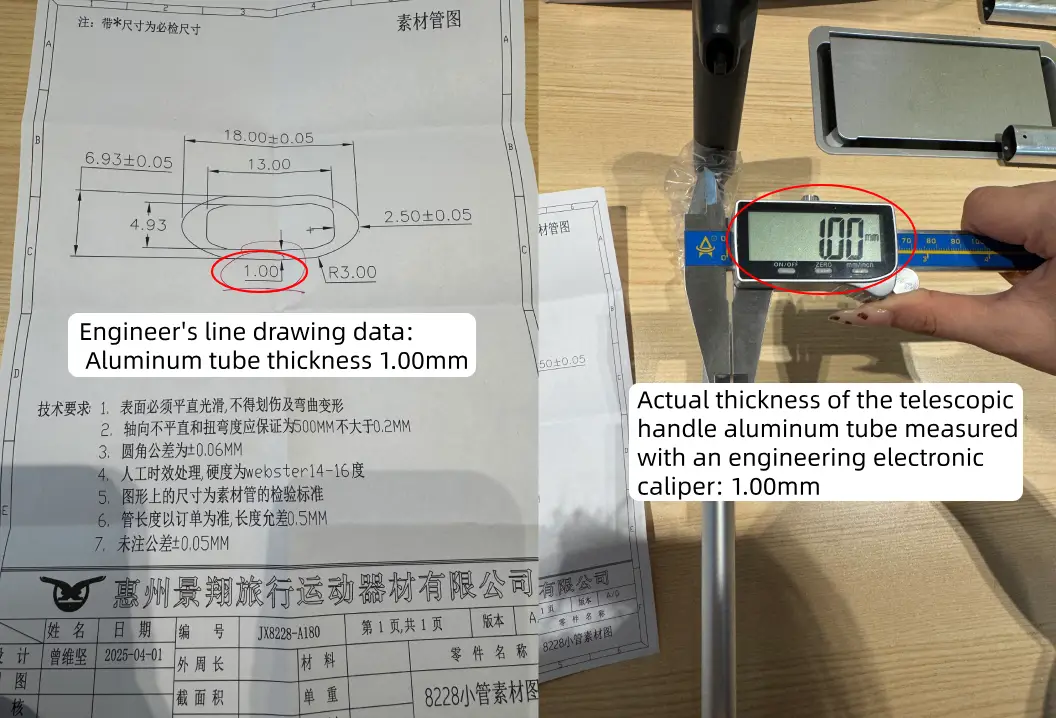
B2B Impact on Brands: Turning Tolerances into Profits
Reduced Warranty Claims
Brands using ±0.05 mm handles report a return rate of ≤0.9% (compared to the industry average of 8.4%), saving annual after-sales costs.
Assembly Line Efficiency
Plug-and-play functionality significantly reduces installation time and increases production efficiency.
High-End Market Positioning
Certified ±0.05 mm extrusion tolerance of telescopic handles enables luxury brands to command a 15-20% price premium and earn the “high-precision” label.