
.webp)
Are you most afraid of the telescopic handle suddenly “breaking down” every time you drag your suitcase to catch a plane or a high-speed train? Either it shakes like a disco dance, or it jams like a rusty iron door, which frustrates users instantly! As a senior manufacturer of luggage accessories, we recommend choosing a telescopic handle that undergoes precise design, offers durability, and delivers multifunctional services.
Kandungan
Sembunyikan
Telescopic Handle Material: Choosing the Right Material is Half the Battle
The common pull rod materials on the market are aluminum alloy, iron, and magnesium-aluminum alloy.
Aluminum alloy: light and easy to carry (suitable for girls and short trips), but slightly weak in compression resistance and may deform slightly under long-term load.
Iron: high bearing capacity (suitable for overweight luggage), but very heavy and prone to rust and corrosion.
Magnesium-aluminum alloy: has both lightness (lighter than aluminum alloy) and high strength (harder than aluminum alloy) and is resistant to falling and oxidation. But the price is more expensive than the other two materials, which manufacturers usually match with high-end luggage. If you have enough budget, you can directly choose magnesium-aluminum alloy!
JX provides custom handle solutions with iron outside and aluminum inside. In addition to the above three materials, JX also provides two/three materials in combination.
Iron outside and aluminum inside can not only reduce some weight but also ensure that the outer layer of the handle is not prone to rust. It has the advantages of both materials and is a very cost-effective solution.
Purchase Tips: Look for the electroplating process on the surface of the luggage handle. The coating of high-quality pull rods is uniform and glossy, and it will not leave marks when scratched with fingernails; inferior pull rods may peel, spot, etc., so pass decisively!
| Material | Density (g/cm³) | Compressive Strength (MPA) | Applicable Scenarios |
| Magnesium aluminum alloy | 1.8 | ≥300 | High-end business suitcases, air consignment |
| Aluminum Alloy | 2.7 | 150-200 | Cabin luggage, short trips |
| Iron | 7.8 | ≥250 | Heavy cargo transportation (terdedah kepada karat) |
Telescopic Handle Sections: More is Not Better
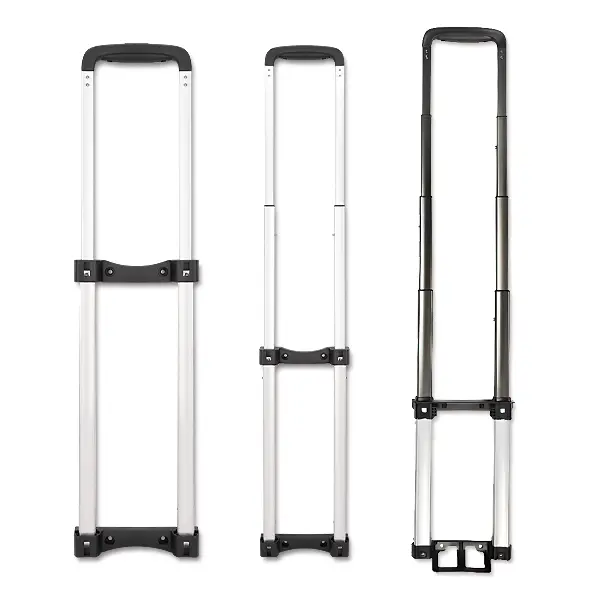
Common pull rods include 2-section and 3-section types:
2-section type: fewer height adjustment levels (usually 2-3 levels), but strong stability, suitable for mainstream heights of 160-185 cm.
3-section type: large adjustable range (4-5 levels); short/tall people can find a comfortable height, but! The more sections, the more joints, the more likely it is to shake!
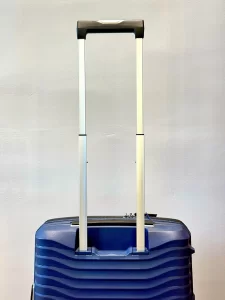
Key inspection: Raise the telescopic handle to the highest level, shake the box left and right, and the shaking amplitude of a high-quality pull rod should be ≤1 cm (national standard GB/T 20940-2007). If it exceeds this value, be alert!
Telescopic Handle Connection: Check Piston & Linkage
The connection between the handle and the suitcase is the most prone to problems! Check in two steps:
The screws at the connection between the plastic parts and the aluminum tube must be fully embedded, without any skewed screws or exposed solder joints. The locking mechanism of the ball bearing can smoothly switch between the “locked-unlocked” states when stretched.
Try pushing and pulling: push the box on the tile/carpet for a few steps to feel the smoothness of the pull rod. A high-quality handle should have no obvious resistance when pushing and pulling, and it can automatically rebound to its position when folded. If there is a “creaking” sound, or it needs to be pressed hard to retract, it will be directly blacklisted!
Telescopic Handle Load-Bearing Capacity: How Much Weight Can Your Suitcase Carry?
Focus on two parameters:
Luggage handle wall thickness: The wall thickness of a high-quality tie rod should be ≥0.8 mm (the vernier caliper is the most accurate). If you don’t have one, pinch it with your fingernails. Only the ones that are hard and can’t be bent are reliable.
Load-bearing test: Regular brands will mark the load-bearing range of the tie rod. It is generally recommended not to exceed 3 times the weight of the suitcase. Contohnya, if the case weighs 5 kg, it is recommended to load no more than 15 kg.
Real scene test: After filling it with 20 kilograms of items, push it and observe whether the tie rod is obviously bent or shakes more. A good luggage handle should be as stable as a mountain.
Telescopic Handle Maintenance: OEM Luggage Handle Parts Replacement Guide
These 3 maintenance tips extend the service life of the suitcase handle.
1. Wipe the trolley handle gap with lubricating oil (olive oil/baby oil) every month to prevent dust accumulation and jamming, which can reduce the return rate by 37%.
2. Avoid carrying boxes with the tie rod in one hand. It is easy to cause the tie rod to deviate and cause unnecessary losses! The correct posture is to hold the bottom of the box with both hands.
3. When not in use for a long time, retract the pull rod completely and store it in a dry and ventilated place.
Summary: 3-Minute Quick Shopping Method
Budget-Friendly, Striving for Perfection → Aluminum Alloy 3-Section Handle (Pay Attention to the Shaking Amplitude!)
Cost-Effective → All-Iron or Iron-Outer-Aluminum-Inner 3-Section Handle
Do not buy→Iron pull rod, unbranded miscellaneous models, loose connection, pemegang teleskopik