
.webp)
The suitcase’s telescopic handle capacity is the unseen measure of a suitcase’s true reliability.
A good suitcase’s telescopic handle should be able to hold at least 30 kilograms (66 磅) without bending or breaking. Higher-end or larger models can usually hold up to 40 kilograms (88 磅).
The distance to the wheel axle multiplies the force on the handle grip. This gives the tube assembly significant leverage.
This article is for people who care about the quality and durability of products. It will explain what the handle really needs to do, the specific testing standards used in the industry, and how real-world data backs up the need for this high capacity.
Problem Scenario: Figuring Out the Real Load on the Handle
People often think that the handle’s strength is the same as the airline’s maximum baggage weight. In reality, the handle is put through a lot of different forces that require a lot of extra engineering.
Why is 30 kg the least amount of suitcase telescopic handle capacity?
Accessory Loading: People often hang extra bags, backpacks, or coats over the long handle. If you put a 7 kg carry-on bag on the handle of a checked bag that weighs 23 公斤 (the most an airline will let you bring), the total vertical load goes up to 30 kg right away.
Dynamic Torque and Bending: The handle is most at risk from the twisting (torsion) and side-to-side bending that happen when the suitcase is pulled over uneven surfaces or curbs or dropped while being moved. The distance to the wheel axle multiplies the force applied at the handle grip, giving the tube assembly a lot of leverage.
Shock Loads: When a baggage handler drops a full 23 kg suitcase or when the case hits something, it creates a force spike (shock load) that can temporarily exert forces that are two to three times the static weight. The handle has to be able to handle this without the tube collapsing or the locking mechanism breaking.
所以, the telescopic handle needs a strong safety margin. This ensures reliable performance under unpredictable, combined stresses.
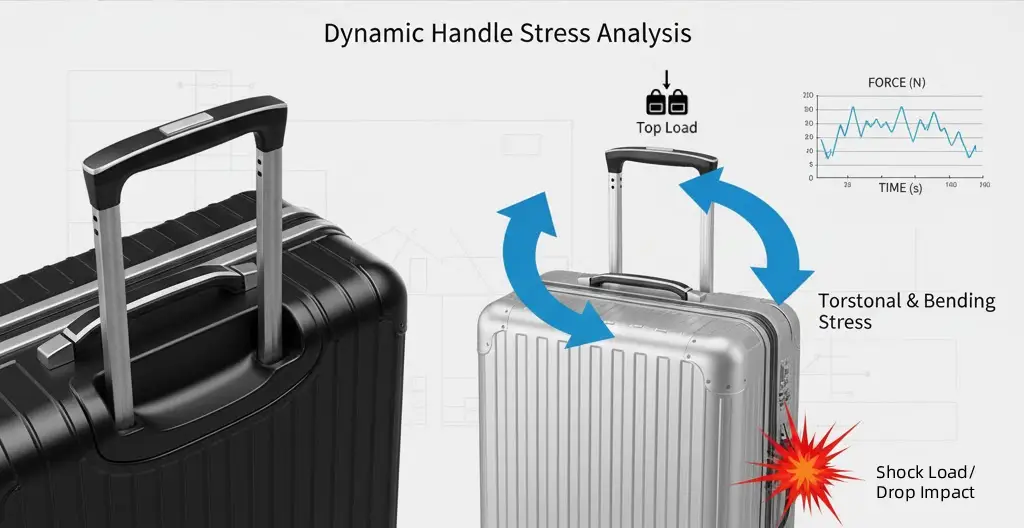
解决方案: Engineering Standards and Material Requirements
Meeting the 30-40 kg capacity requires more than a simple pull test. It demands stringent design, 材料选择, and standardized testing.
Key Engineering Requirements:
| Test Protocol | Target Capacity Goal | 材料 & Design Focus |
| Static Load Test | 30 kg – 40kg | Tube Material: 铝合金 (例如。, 6063 series) to prevent permanent deflection. |
| Cycling Test | 4,000 到 5,000 周期 | Locking Mechanism: Precision-machined springs and buttons to ensure non-failure under repeated use. |
| Wobble/Torsion Test | Minimal Lateral Play | Tube Fit: The tolerances between the telescopic tubes are strictly maintained at ±0.02 mm. This accuracy reduces handle wobble and prevents undue stress on the base. |
The choice of aluminum alloy is critical. It must have a high strength-to-weight ratio. Standard commercial aluminum might bend, but high-quality alloys give the pull rod the stiffness and resistance to metal fatigue it needs to keep working after thousands of extension cycles and many high-stress events.
By requiring a minimum capacity of 30 公斤, manufacturers ensure that their product can handle normal user overloads and the bumps that come with moving luggage. This strict standard directly reduces the risk of returns or warranty claims due to structural failure.
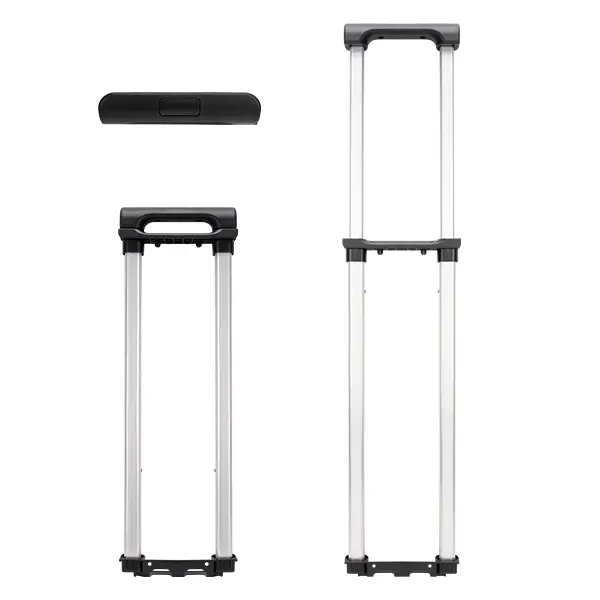
Case Data: The Price of a Broken Suitcase Handle and Reports from the Industry
Data from the industry on baggage damage shows that durability often fails in real-world situations, which shows how important it is for a suitcase to have a high telescopic handle capacity.
According to the SITA Baggage IT Insights 2024 Report, damaged or stolen luggage accounted for 15% of mishandled bags globally. SITA is a well-known source in airline baggage handling. This is from a well-known source in the airline baggage handling industry. This category includes all kinds of physical harm, but the handle system is a high-risk failure point. When a handle is broken, bent, or stuck, the bag can’t be used for its main purpose, which is to make it easy to carry. This is often why people say a bag is “damaged.”
Quality Validation Based on Data:
This 15% damage statistic indicates that handling forces are both strong and frequent. A manufacturer that says its handle can hold 30 kg shows that it has built in a safety factor to lower the risk of this known damage.
Verification for Customers (Checklist Before Buying):
- Flex Test: Pull the handle all the way out. Lift one side of the whole case slowly with just the corner of the handle grip. A good suitcase handle won’t bend much side to side, and the lock will stay tight.
- Tube Diameter: Thicker tubes usually mean more capacity.
- Base Connection: Check the part of the assembly where the handle tubes go back into the suitcase shell. Instead of a small plastic housing that could break when it hits something, look for a strong, wide base plate that spreads the load over a large area.
Choosing a handle that meets strict capacity standards increases reliability. It also lowers the chance of breakdown during travel.
简而言之, the handle of a suitcase should be able to hold a lot more weight than the bag itself, which is usually between 30 和 40 公斤. This requirement provides a structural safety buffer. It handles extreme dynamic forces, torsion, and shock loads during travel. This directly reduces the real-world baggage damage risks that industry reports like those from SITA have pointed out.
View more custom solutions for telescopic handle load capacity and design at 行李手柄.
——————
Author and Copyright: Boluo Jingxiang Travel & 体育设备有限公司, 有限公司. (JX行李零件)
Phone: (86) 18207524958
电子邮件: Productmanager@Jxluggageparts.com